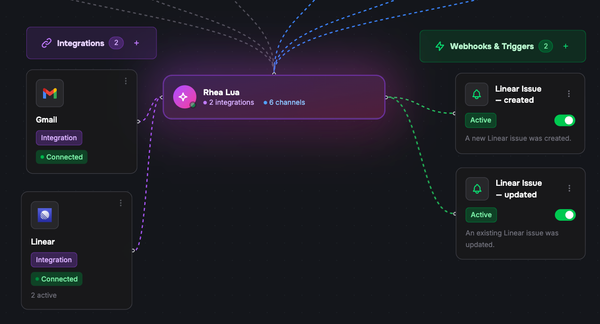


You don't call five departments when you book a holiday. You talk to one person who knows how to reach all of them. Today we're shipping Spaces — supervisor agents that coordinate fleets of specialised agents in a single, intelligent conversation.
Most organisations building with AI agents end up in the same place within six months: a growing collection of specialised agents that each do one thing well, and a user experience that requires people to know which agent handles which task. A weather agent over here. A bookings agent over there. A news digest somewhere else. The AI works — the orchestration doesn't.
Spaces is the answer to that. A Space is a supervisor agent — an intelligent coordinator that sits in front of your fleet, understands what each specialist can do, and routes every user request to exactly the right place. The user talks to one entity. The Space handles everything behind it.
It's not a wrapper. It's not a router with a config file. A Space reasons about the task, decides which supervised agent or combination of agents is best placed to handle it, delegates the work, and synthesises a coherent response back to the user. Every step is logged. Every delegation is tracked.
How It Works
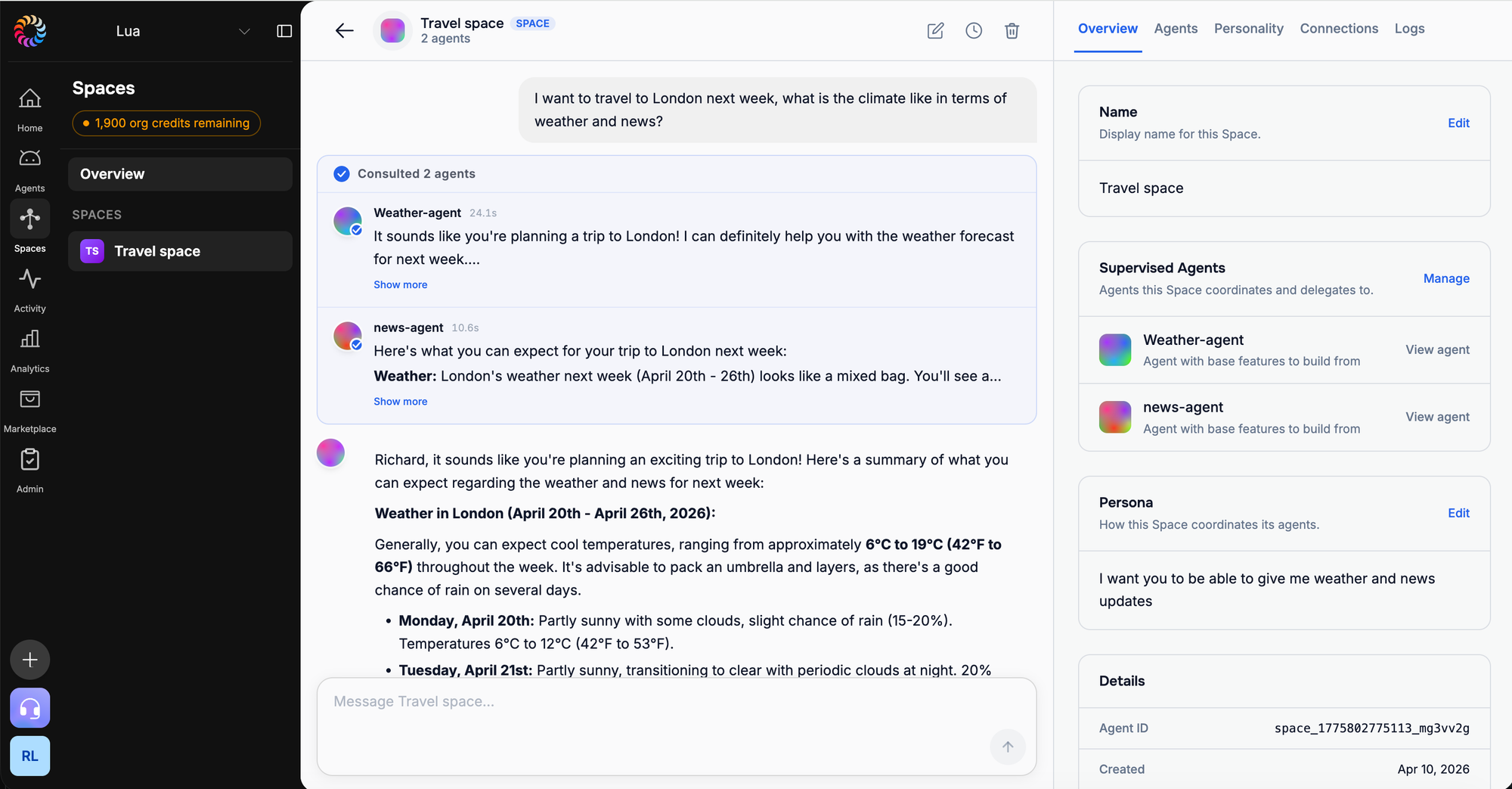
Creating a Space takes minutes. From the Lua dashboard, you give it a name, write (or generate) a persona, and select which agents it supervises. The platform reads the description and capabilities of each agent you attach and automatically composes an orchestration persona — the Space knows, at the prompt level, what each of its agents is good at and how to hand work off to them.
What This Looks Like in Practice
Take a travel agency as a hypothetical. They've built three specialised agents: one that reads live weather and climate conditions for any destination, one that surfaces travel advisories and destination news, and one wired into their booking platform for flights, hotels, and transfers.
Each agent does one thing well. But customers are ending up in three separate conversations depending on what they need — and most of the time, what they need spans all three.
"What's the weather like in Lisbon in October?"
→ Talk to the weather agent
"Are there any travel advisories?"
→ Switch to the news agent
"OK book me flights from London, 12th October, two adults."
→ Switch to the booking agent
"I'm thinking Lisbon in October for two — what's the weather usually like, anything I should know, and can you book it?"
→ Space delegates to all three agents in parallel, synthesises a single response, and presents booking options with weather context already included.
With a Space — call it "Travel Concierge" — those three agents sit behind a single interface, embeddable on any homepage via Lua Pop. The customer asks one question and gets a complete answer. No new infrastructure, no rebuilt workflows, no restructured agents. One Space added, and the architecture that was already working starts working together.
That's the hypothesis: the compounding value of specialised agents isn't in any single agent — it's in what happens when they share a conversation.
A Space doesn't replace your agents. It makes them coherent — to the user, and to each other.
What's Inside a Space
A Space is a full agent — not a lightweight configuration layer. Everything you can do with a standalone agent, you can do with a Space.
More Ways Teams Are Using Spaces
The travel use case is intuitive, but Spaces generalise to any domain where multiple specialised agents need to feel like one coherent intelligence.
Attach an order tracking agent, a returns processing agent, and a product recommendation agent to a single Space. A customer can ask "where's my order, can I return it, and what should I get next?" — one conversation, three agents, one coherent answer. No hand-offs. No confusion.
A market data agent, a news aggregator, a portfolio analysis agent, and a compliance screening agent — all coordinated by a single Space. An analyst asks one question; the Space pulls live data, surfaces relevant news, checks the portfolio, and flags anything the compliance agent catches. All in one response.
Appointment booking, symptom triage, insurance verification, and post-visit follow-up — four agents that each touch a different system, coordinated by a Space that makes the entire experience feel like one helpful conversation. Built with proper persona boundaries so the Space never oversteps its lane.
Concierge, booking, food & beverage, housekeeping, and task management — all coordinated through a single Space connected to WhatsApp. Guests message one number. Staff work in their existing tools. The Space routes everything.
The Technical Bit
For teams building on top of Lua, a Space is a first-class agent with its own ID and API surface. All the same endpoints that manage standard agents also manage Spaces — create, read, update, delete, and a set of endpoints specifically for managing the supervised agent roster.
At runtime, the Space resolves the full capability set of each supervised agent dynamically. Supervised agents are isolated — each gets its own context and memory segment, so they can't contaminate each other's state. Circular references (a Space trying to supervise another Space that supervises it back) are prevented automatically.
Delegation telemetry is built in: every agent handoff records the target agent ID, execution time, and success state. These events are queryable from the dashboard and available as webhook payloads for downstream observability tooling.
The teams that build specialised agents first and coordinate them second ship faster than the teams that try to make one agent do everything.
Available Now
Spaces are live on the Lua platform today. If you already have specialised agents running, you can create your first Space in under five minutes. Pick a name, select your agents, review the generated persona, and deploy.
If you're starting from scratch — or want to rethink how your current agents are structured — Spaces are the right abstraction to design around. Build your specialists first, keep them focused, and let a Space handle the orchestration.
The pattern that scales isn't one agent that does everything. It's many agents that each do one thing well, coordinated by something that understands the whole.
Already on Lua? Head to the Spaces tab in your dashboard.
New to Lua? Start building for free.