
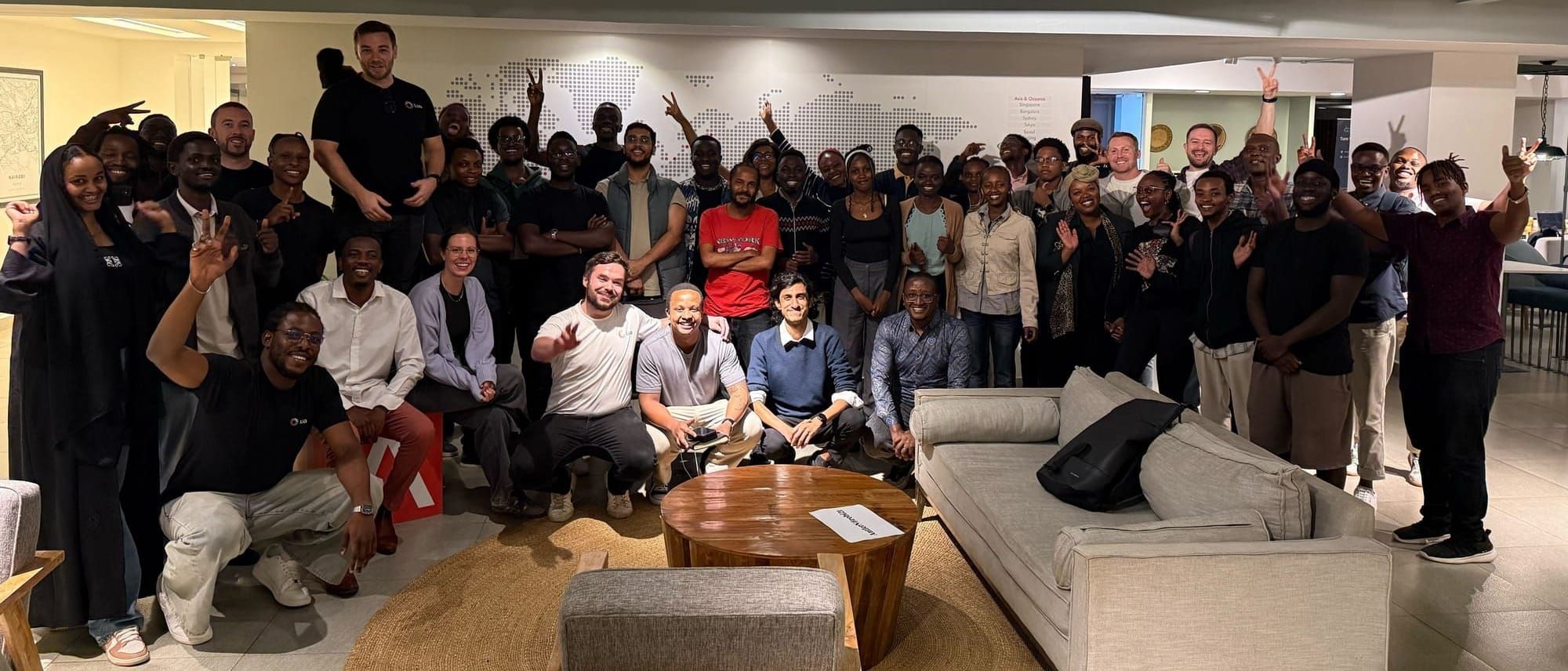
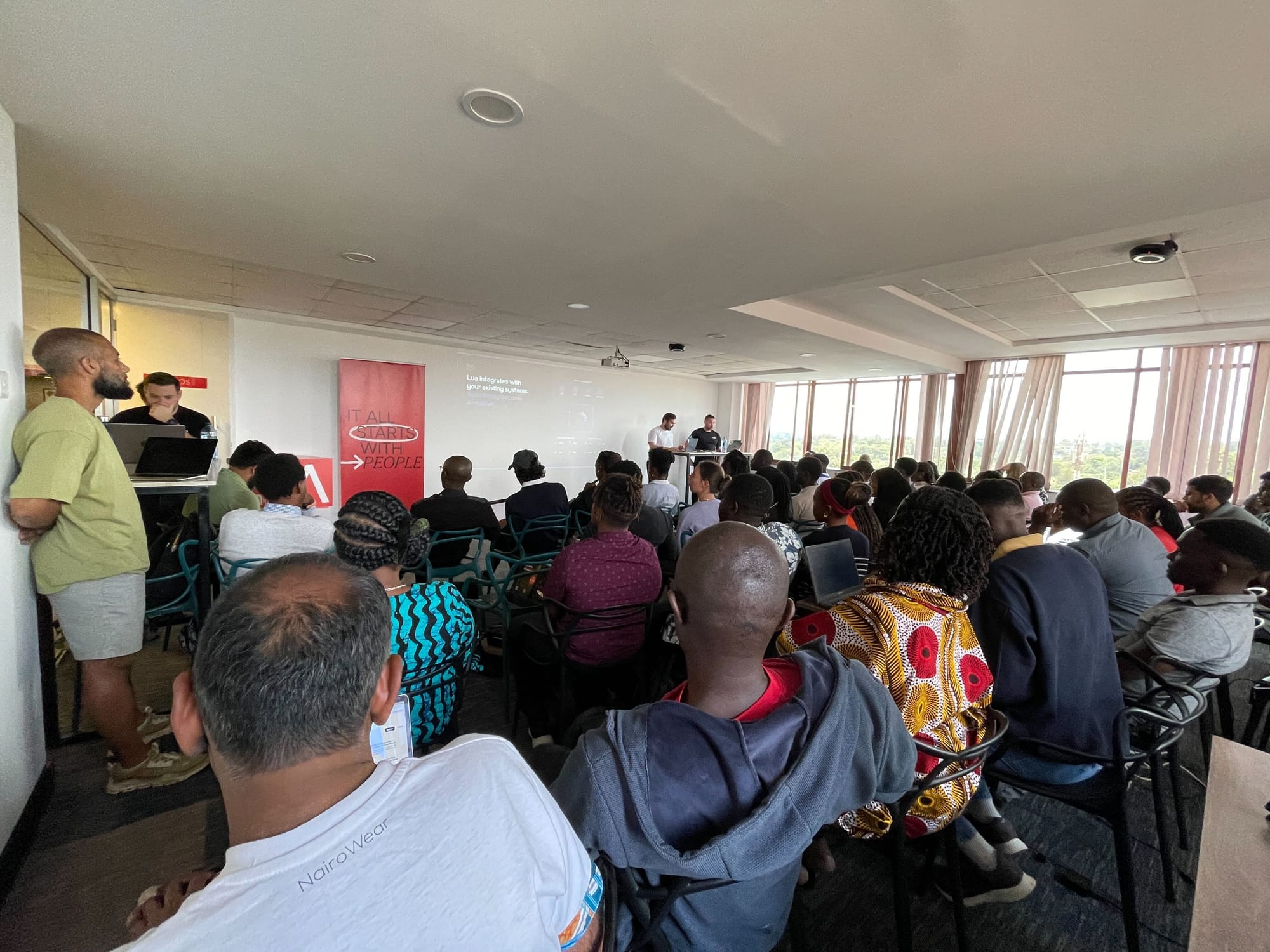
Last Thursday, 120 people showed up to a room in Nairobi to build AI agents. Not to listen to a panel. Not to network over coffee. To build. Business owners who had never written a line of code sat next to developers who ship production systems for a living — and by the end of the day, dozens of working projects had been demoed and judged.
This wasn't an academic exercise. It was a room full of people who looked at a real problem in their life — poultry farming, loan applications, house hunting, end-of-life planning — and decided the answer was an agent.
What made it remarkable wasn't just the volume. It was the range. The participants spanned from first-time builders using no-code tools to developers wiring up custom API integrations and multi-agent swarms. And the ideas they brought weren't hypothetical. Almost every single one was anchored in a business they either run or a problem they've personally felt.
The Ideas Were Real
This is the thing that separates what happened in that room from most hackathons. These weren't solutions looking for problems. They were problems that already had someone losing money or time — and the agent was the fix.
Thousands of Kenyan MSMEs get turned away by banks — not because they're not creditworthy, but because they can't translate their M-Pesa transaction history into the structured financial proposal that banks require. Allan's agent takes raw M-Pesa statements and outputs a complete, formatted financial proposal as a PDF. That's not a demo. That's a product.
Small traders across Kenya still track daily sales by hand — and forget half of it by closing time. Diko connected his agent to the Daraja API so every M-Pesa transaction gets automatically logged to a Google Sheet. No manual entry. No forgotten sales. Real money accounted for.
Emmanuel is a poultry farmer. His agent monitors the variables that impact egg production — temperature swings, nutrition gaps, lighting conditions — through IoT thermostats, and can actually control the devices to correct problems before they affect output. He built a Twilio integration for alerts and a proper developer route. This isn't a prototype. It's ready to deploy.
Peter designed a swarm of agents to manage an entire resort — concierge, booking, food and beverage, housekeeping, customer success, and task management — all coordinated through WhatsApp using Lua Spaces. One of the most ambitious architectures of the day.
End-of-life planning. The entry point is a question nobody wants to think about but everyone eventually faces: "My dad died — what's my immediate checklist?" Theresa's agent provides that free checklist, then upsells into lifetime subscriptions and insurance claim processing. She'd already connected the web widget to her live site. Multiple skills and tools built in.
The Talent Ran Deep
What struck us most was the technical range in the room. Some builders had full API integrations wired up before lunch — Daraja for payments, Twilio for comms, Firecrawl for scraping, custom webhooks pulling from WhatsApp and social platforms. Others were first-time builders who had never touched an API but still shipped a working agent with real skills by the end of the day.
Other standouts included Christine's Bunifu Capital Agent — which analyses a creative's income streams and generates a risk score for lenders — Hardley's CoreKind Solutions, which unifies HubSpot and other automation tools into a single agent-powered SaaS platform, and John Alexander Kamau's Prospector, a second-brain agent that ingests company DNA and builds prospect lists with integrated email send and receive.
The non-technical builders were just as impressive. Amariah built an AI receptionist handling booking and scheduling. Amon built Nyumba, a house-finding agent that matches listings based on budget, neighbourhood, and unit type. Perpetua brought her actual popcorn events business — Doree Pops — and built an agent to identify top-performing flavours. These are real business owners solving their own problems.
Every project was built around the distribution channels people already use — WhatsApp, M-Pesa, Google Sheets. That's what building AI that works actually looks like.
The Energy Was Unmistakable
There is something happening in Nairobi right now that's hard to explain without being in the room. 120 people spent their Saturday building — not attending, not spectating, building. The mix was the story: a poultry farmer sat two tables from a treasury tool developer. A popcorn vendor worked alongside someone designing multi-agent resort management systems. A student built a lending risk engine. An architect designed a platform for vernacular buildings.
The participants didn't need to be convinced that agents are the future. They already knew. They came with the problem already in their head and spent the day turning it into something that works.
Not all projects were finished. Some had agents that weren't quite functional yet. Some had ambitious architectures without APIs connected. That's fine — that's what a hackathon is. What mattered was that every single person in that room was building toward something real, for a market they understood, with distribution they could see.
Loan proposals from M-Pesa data. Automated sales ledgers for market traders. Poultry farm automation. End-of-life planning. Security systems running on Raspberry Pi. Grant discovery for NGOs. WhatsApp-native commerce. Mental health support. Environmental compliance screening.
These aren't Silicon Valley thought experiments. These are the problems sitting in the middle of the fastest-growing economies on the planet. And the people solving them were all in one room, on one Saturday, in Nairobi.
Next Up: Singapore
We're not slowing down. This Saturday — April 18th — we're running the $1 Sprint in Singapore with AI.SEA. Same energy, different rules: you walk in with a business problem, build an agent, and by 6pm someone has to have actually paid you for it. Not a demo. Not a prototype. A real transaction.
The dollar is almost beside the point. What matters is that someone said yes. That's a different skill from building, and it's the one that compounds.
If you're a developer who's built things but never sold them, a technical founder who wants to stress-test an idea fast, or an agency builder who wants to add AI agents to their offering — this is the day.
Saturday, 18 April · 9am – 6pm · Free to attend
Organised by AI.SEA · Powered by Lua AI