


By Emmanuel Mafabi Israel
Hi, I'm Emmanuel. I am a Systems Engineer, the Steward of Mafabi Innovations, and the creator of AvisOS — an Aviary-Based Agentic System designed to give poultry farmers 24/7, real-time autonomous oversight of their flocks.
I want to share the story of how a Weekday Agent-Led hackathon, a dose of initial skepticism, and a powerful AI framework helped me build a solution to one of the most stressful problems in agriculture.
The Hackathon: From Skepticism to an "Alas!" Moment
To be completely honest, my journey into agentic AI started with a healthy dose of doubt. When a brilliant business coach of mine, Emmanuel Mbogholi, reached out and encouraged me to join the Lua AI hackathon, I was highly skeptical. Why should I go? Is this just another tech hype cycle? I jotted down my "Why's," ultimately surrendered it out to the Lord, and decided to go with the flow; mostly for the experience and to connect with the engineers behind Lua and Antler.
Then, I opened the Lua documentation and started going through it.
I had an immediate "Alas!" moment. Previously, building AI agents felt daunting and convoluted. But Lua's platform felt like it was straight out of modular manufacturing. Defining the Skills, Tools, and Webhooks wasn't just logical; it was unbelievably intuitive. I realized right then that I had the perfect infrastructure to tackle a problem I had been watching closely in my own family's business.
The Problem: The Fragility of the Flock
I looked at the commercial layers farm managed by my sister. Managing a poultry farm — especially pullets (young layers) — is not an easy task; it is akin to walking a tightrope.
Commercial layer poultry are extraordinarily sensitive to their environment. One false move, a slight temperature spike, or a drop in calcium doesn't just cause temporary discomfort. It triggers what I call a physiological degrading cascade. This can lead to premature molting, disease introduction, severe mortality, or a complete halt in egg production — a general loss in revenue!!!
Too often, poultry farming feels like playing a probability game. By the time a farmer physically notices heat stress or a nutritional drop, the biological shock to the flock has already occurred.
By the time a farmer physically notices heat stress or a nutritional drop, the biological shock to the flock has already occurred.
The Solution: AvisOS
I realized we could use Lua to build a future where farmers don't feel neglected or forced to guess about the health of their birds. I built AvisOS.
AvisOS is not just a dashboard; it is an autonomous digital farm manager. While the farmer or their employees are away, AvisOS continuously monitors the vitals of the poultry cells — ambient temperature, water intake, soft shell counts, and more. If a stressor is detected, AvisOS doesn't just log it; it acts. It can autonomously trigger cooling systems, dispatch emergency WhatsApp alerts to the farmer, or even send automated purchase orders to suppliers if it detects a nutritional deficiency in the feed.
Continuously watches ambient temperature, water intake, feed weight, and soft shell counts across every poultry cell.
Dispatches emergency WhatsApp messages to the farmer the moment a stressor is detected — before the flock is affected.
Triggers cooling systems autonomously and sends automated purchase orders to suppliers on nutritional deficiency detection.
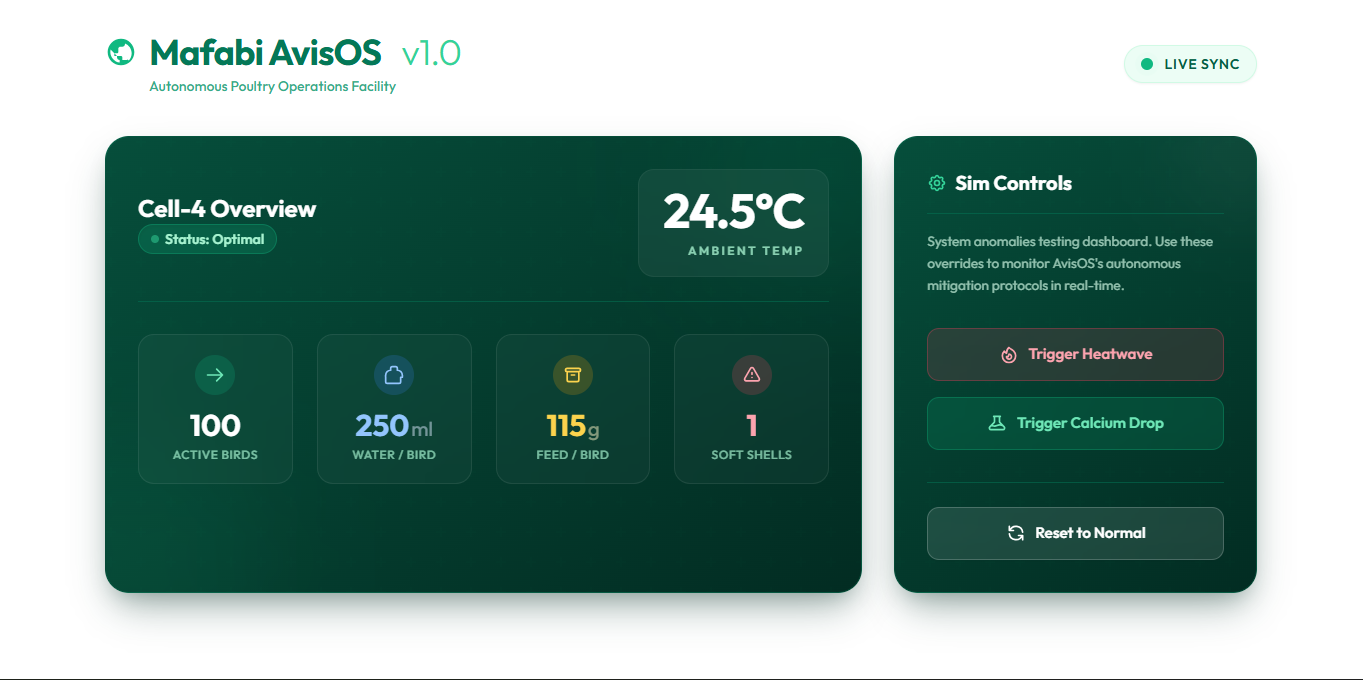
Agent Dashboard — Cell Overview
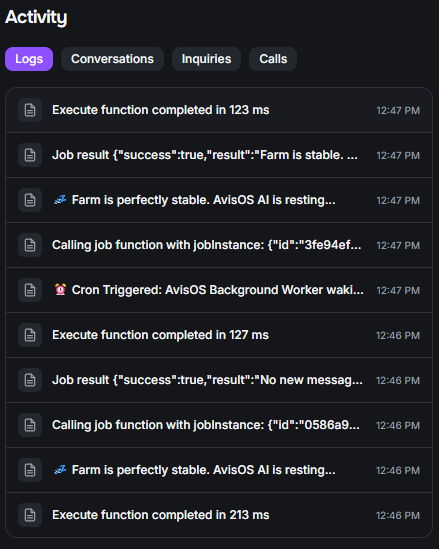
Activity Logs — Autonomous Cron Runs
The Architecture: How the Agent Works
To make this reliable in a harsh agricultural environment, I engineered a decoupled, microservice architecture. Here is how the system flows:
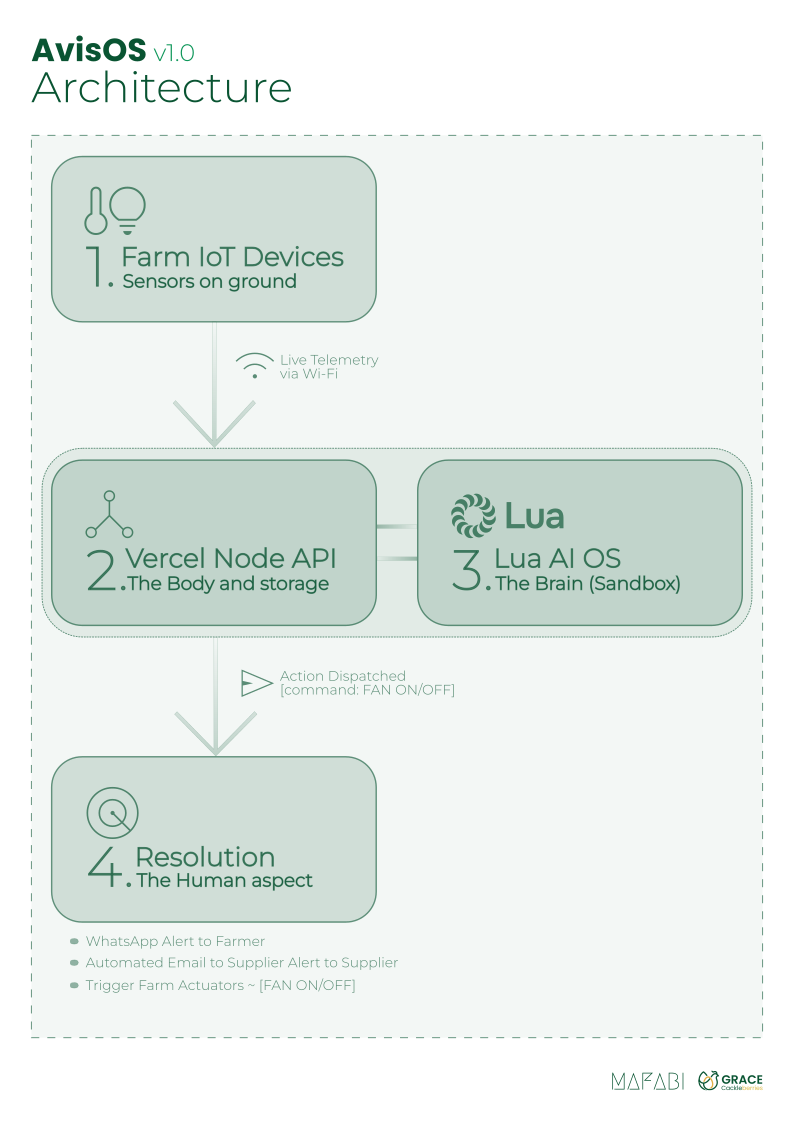
Physical IoT sensors — Raspberry Pi Pico W and DHT22s — gather live temperature, humidity, and feed weight data from the poultry cells.
This data is securely POSTed to a central backend hosted on Vercel, which acts as the system's nervous system and database router.
Operating in a secure, sandboxed environment, the AvisOS agent runs on an autonomous Cron job. It wakes up, fetches the data from the Vercel Hub, and uses its LLM reasoning to determine if the flock is in danger.
If action is required, the Lua Brain simply tells the Vercel API what to do. The backend handles the heavy lifting of executing alerts or emails, keeping the agent lightweight, fast, and secure.
Gratitude and the Vision Forward
I am profoundly thankful to God for the experience and the incredible people I met during this sprint.
I want to extend a massive thank you to the HeyLua team: to Richard, for possessing a technical mind so similar to my own and showing such deep interest in the architecture; to Lorcan, for his warm, inviting demeanor, and seeing the vision; to Donal, for his support; and to Stefan, Lua's CTO, for his brilliant vision of device primitives that aligns so perfectly with IoT integrations.
At Mafabi, our core vision is Digital Stewardship; using technology to help people steward what God has given to them well and wisely. AvisOS is the manifestation of that vision. It is about returning poultry farming to what it should be: a fulfilling, manageable enterprise where farmers have real-time eyes on the ground, 24/7.
We are just getting started.

Founder & CEO, Mafabi Innovations
Empowering African Ambition through AI | Machine Learning & Systems Engineer | Lifelong Learner | "About My Father's Business"
Connect on LinkedIn →