

"Should this be a person or an agent?" sounds like a question with two sides. It isn't. The teams getting the most out of this moment don't pick a side — they work out how humans and agents share the work, role by role. We built a tool with Talent Safari to start exactly that conversation.
The collaboration came from a hunch that Talent Safari and Lua kept arriving at from different directions. Talent Safari spends its days placing excellent people into roles. Lua spends its days building agents that take the repetitive weight off those same people. That can look like a rivalry. It's the opposite: we're both trying to put the right capability behind every function — and more often than not, the best answer uses some of each.
What neither of us could say well on our own is that the human-or-agent framing is usually too blunt. A founder buried in support tickets at 11pm doesn't need a manifesto about the future of work. They need to see, for this specific role, which parts a person should own, which parts an agent can carry, and how the two hand off to each other. So we built something that shows them.
Meet Ada — she reads a role and shows you the split.
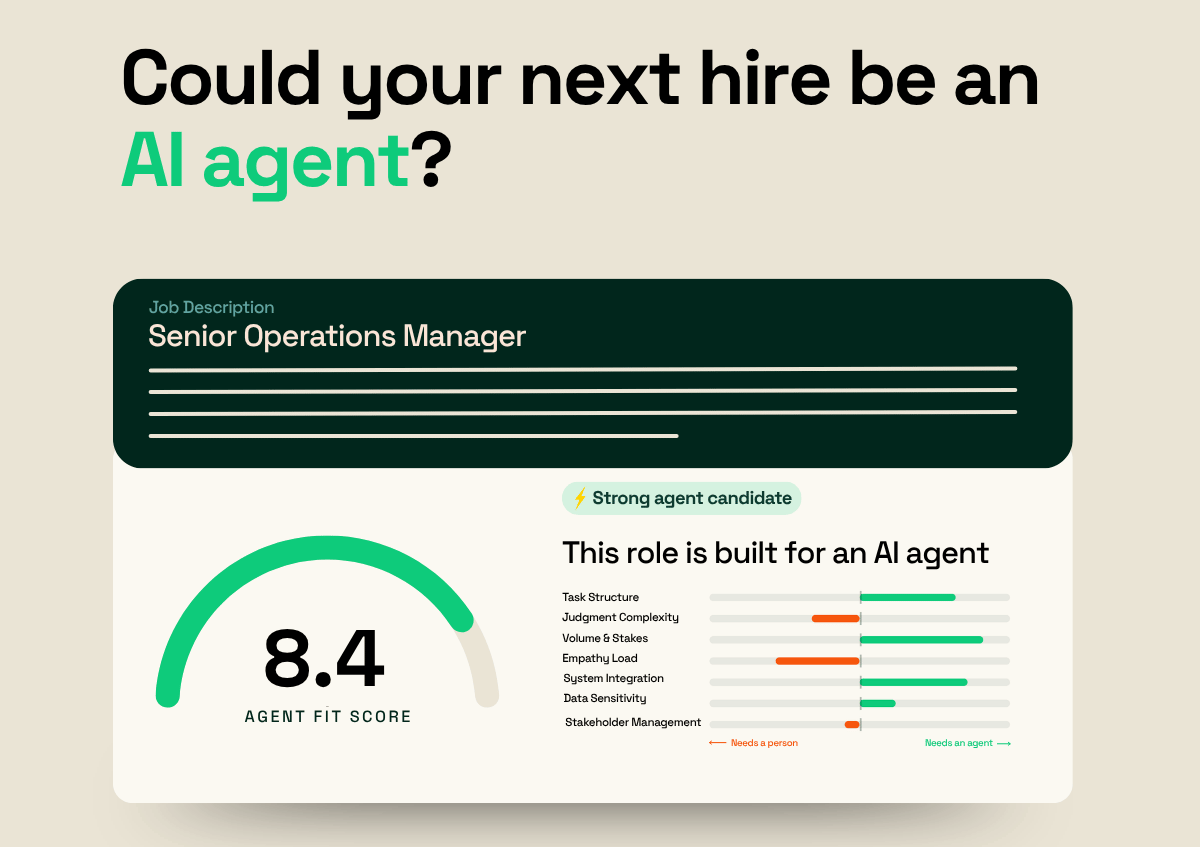
The premise is simple. You paste in a job description — or just describe the role in plain language — and Ada reads it the way a thoughtful hiring panel would. Three quick calibration questions sharpen the picture: how novel the day-to-day work is, how much volume the role generates, and who the role actually talks to. Then Ada scores the role across seven dimensions and shows you where the work naturally sits between a person and an agent.
Each dimension is scored across the same axis: how much of that part of the role a person should carry, and how much an agent can take on. The single verdict is just the headline — the breakdown is the real output. In this example, an agent can absorb the hundreds of routine tickets while a person stays free for the escalations that need empathy and judgment. That's not a role being replaced. That's a role being made better to do.
"The most interesting roles aren't the obvious ones. They're the ones where a person and an agent split the work — and each ends up doing more of what they're actually good at."
The mix is the strategy.
The lazy version of the AI conversation is "replace your team with agents." That's not the future we're building toward, and it's not the future Talent Safari is staffing for. The version both of us believe in is one where the balance of humans and agents is a deliberate decision, made role by role, with the two designed to work together rather than compete.
Take the routine, high-volume parts of a role off a person's plate and you don't shrink the person — you free them for the work that needed a human all along: the judgment calls, the relationships, the messy edge cases, the moments where someone needs to feel heard. The agent handles the first ninety tickets so the person can be fully present for the ten that matter. Done well, people end up doing more of what they're good at, and so do the agents.
And here's the part we're proud of: whatever Ada surfaces, both partners are right there to help with their side of it. If a role is mostly a person, Talent Safari sources and vets the right candidate. If it's mostly an agent, Lua scopes and builds one. And when it's a blend — which it usually is — you do both, and they work side by side.
Agents aren't software you bought. They're teammates you onboard.
This is the belief that made the campaign click for both teams. When you build an agent on Lua, you're not switching on a feature — you're adding a teammate. The agent gets a name, a clearly-owned slice of the work, and the same accountability you'd hold a person to. It sits in the same team, in the same tools, handing work back and forth with its human colleagues. Ada is one of those teammates. So is every agent we run inside Lua to help our own small team move like a much bigger one.
The question was never human or agent.
It's "how do a person and an agent share this work, so each does more of what they're best at?" — asked honestly, one role at a time. That's the question this tool exists to help you answer.
That's why we built this with Talent Safari, not against them. The org chart we're both working toward isn't all people or all agents — it's a deliberate blend, where your agent teammates have names and responsibilities right alongside your human ones, and the handoffs between them are designed on purpose. Talent Safari makes the human side excellent. Lua makes the agent side real. The tool is just the front door to the conversation about how they fit together.
Curious how a role would split?
Paste the job description. See where a person and an agent each fit — in about fifteen seconds.